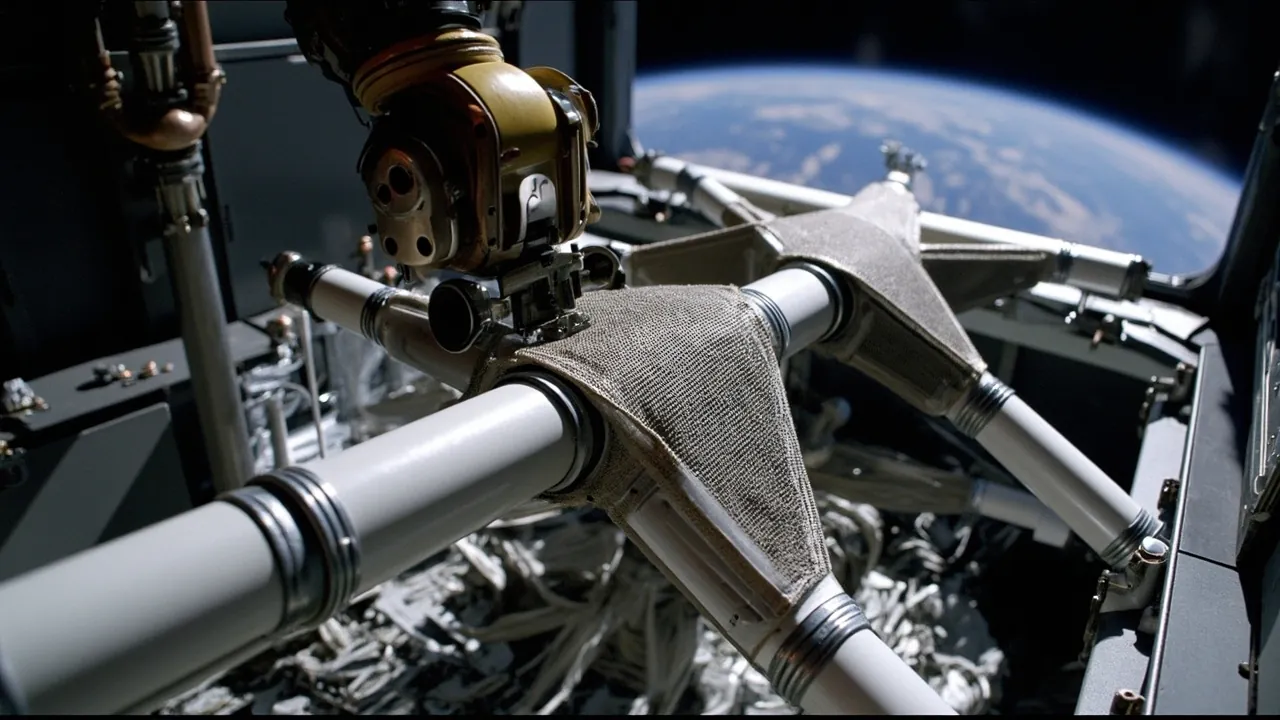
A groundbreaking achievement has been made in the realm of space exploration as a robot developed by researchers at the California Institute of Technology (Caltech) successfully assembled part of a structure in space without any astronaut intervention. Dubbed the Autonomous In-Space Tensioned Reflector Assembly (ASTRA), this robotic system was launched into orbit on March 30, 2026, as part of SpaceX's Transporter-16 mission. The system joined individual components to build a section of an experimental antenna while aboard Momentus' Vigoride orbital vehicle, demonstrating the potential for future space structures to be constructed beyond Earth. This development is part of the US Defence Advanced Research Projects Agency's (DARPA) Novel Orbital and Moon Manufacturing, Materials and Mass-efficient Design (NOM4D) programme, aiming to construct very large structures in space.
The robotic system, resembling construction toys such as K'Nex or Tinkertoys, uses an autonomous manipulator that collects struts and joints from nearby dispensers and connects them to create sections, or bays. The process allows the robot to build a larger structure one section at a time, with each section attached by a thin, net-like reflective surface. The experimental antenna was designed to measure 1.4 meters in diameter and used composite fibre tubes, aluminium joints, and a reflective Kapton surface. The robotic system successfully constructed an additional section of the truss while operating in orbit.
Assembling structures in space presents practical challenges due to the limited room for cargo in rockets. Traditional solutions have involved folding structures before launch and unfolding them after reaching orbit, or sending large components through multiple launches and assembling them manually. Building structures directly in space could offer another way to overcome these restrictions, enabling construction on a scale that could eventually reach hundreds of metres or even kilometres. DARPA's NOM4D programme aims to support future space-based radio antennas, large solar arrays, habitats, and powerful space telescopes capable of observing distant objects by developing methods for constructing very large structures beyond Earth.
The ASTRA payload travelled to low Earth orbit aboard SpaceX's Transporter-16 mission on March 30, 2026, with Momentus providing support by hosting the payload on its Vigoride orbital vehicle and offering services such as communications, power, and imaging. The payload carried two preassembled sections of the truss, along with a robotic manipulator and the components needed to build another section. After reaching orbit, the team released the launch restraints and deployed the two prebuilt sections. The robot then began assembling the next section using components stored in motorised dispensers, with careful coordination between the researchers on Earth and the system in orbit.