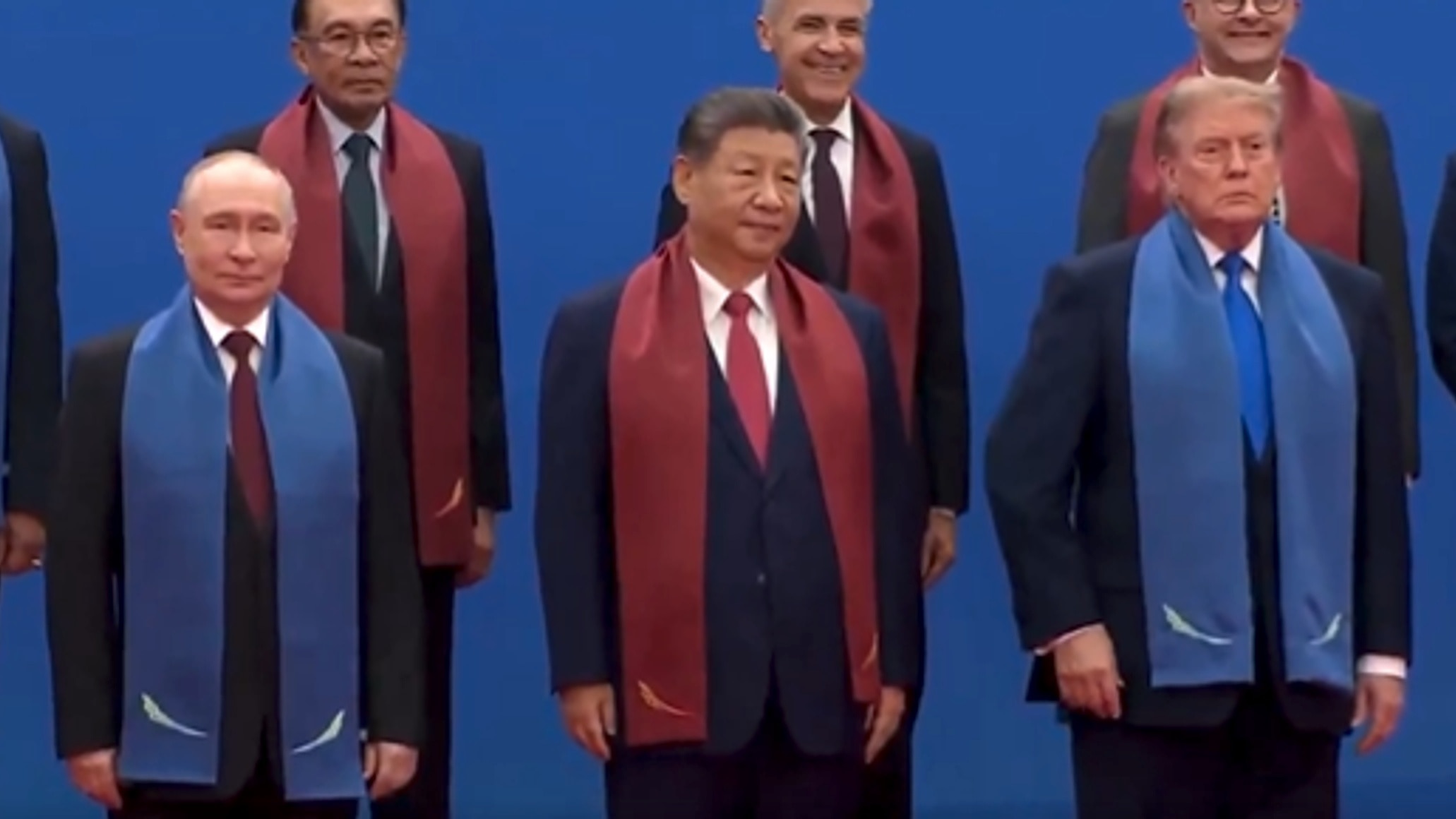
In the bustling city of Shenzhen, China, the annual Asia-Pacific Economic Cooperation (APEC) summit commenced with the participation of world leaders. At the forefront was US President Donald Trump, who looked forward to a trilateral meeting with Chinese President Xi Jinping and Russian President Vladimir Putin to discuss potential avenues for cooperation. The three leaders are expected to delve into various global issues, including the ongoing Ukraine conflict and the Iran war.
The summit marks a significant moment in diplomacy as it is the first time since Mao Zedong welcomed Soviet leader Nikita Khrushchev that a Chinese leader has personally greeted a visiting head of state at the airport - in this case, President Trump. The warm welcome was reciprocated from the US side during Xi Jinping's state visit to Washington in September.
President Trump also took the opportunity to highlight the US as the world's largest energy supplier and emphasized his administration's efforts to expand the country's energy capacity. He expressed pride in the peace agreement between Cambodia and Thailand and reiterated the US' commitment to the Asia-Pacific region, stressing the importance of stability and peace.
Meanwhile, Chinese President Xi Jinping called for free and open trade, stronger regional economic cooperation, and greater integration among Asia-Pacific economies. He also stressed the need to uphold open regionalism, create a fair and non-discriminatory business environment, and remove barriers to economic growth in the region. Furthermore, Xi Jinping announced that China would provide $20 million to support practical cooperation within APEC and establish an Asia-Pacific Community Research Centre in Shenzhen.
The summit, with its trilateral discussions and high-level commitments, promises to shape the economic and geopolitical landscape of the Asia-Pacific region for years to come.